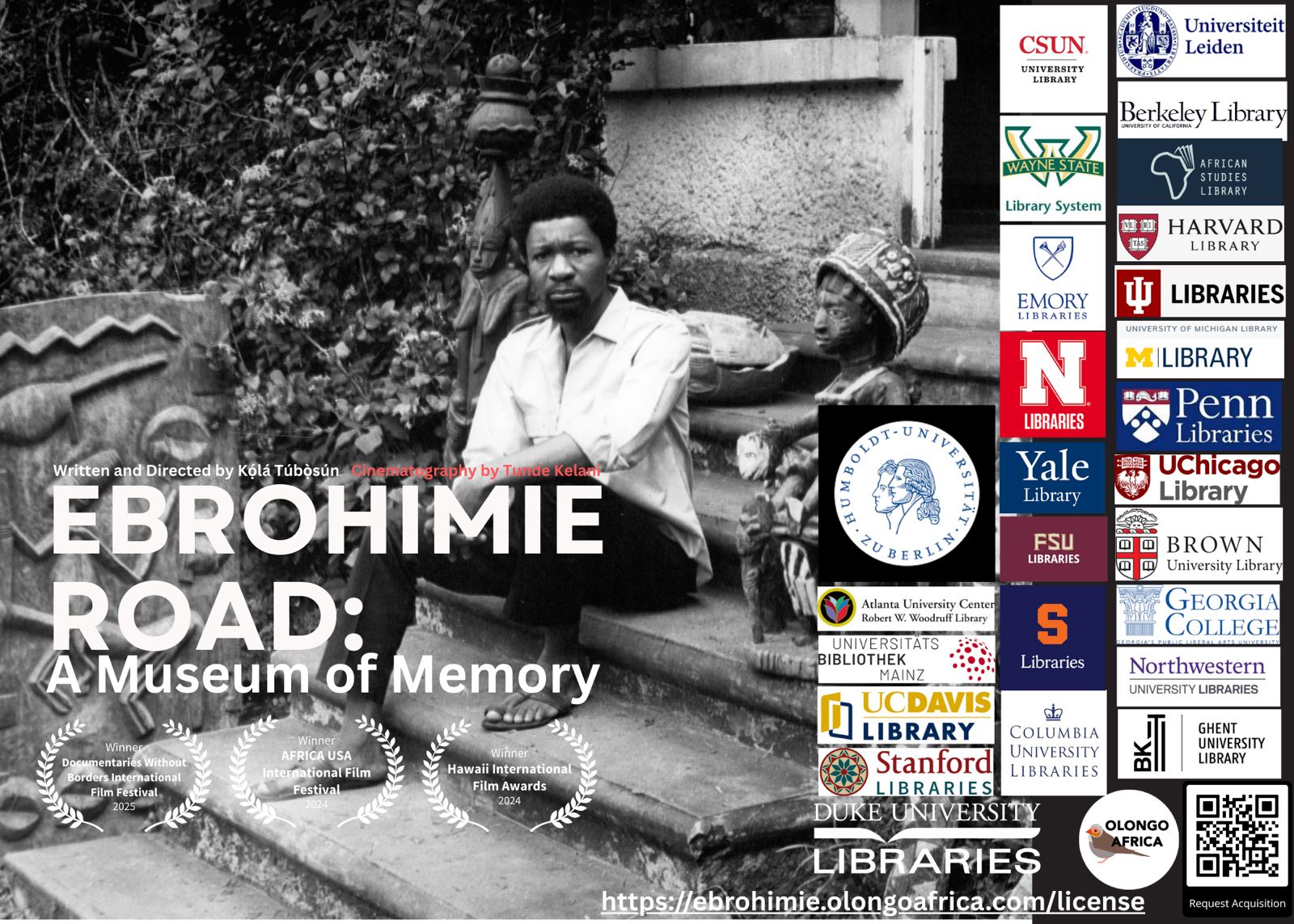
Since 2024, Ebrohimie Road: A Museum of Memory has been acquired for use by over two dozen universities and institutions in the US and around the world as an educational and research material — from Yale, Harvard, Stanford, Penn, Columbia to Indiana, Leiden, Humboldt, Duke, Indiana, and Chicago. See institutions near you on WorldCat
Because it touches on numerous universal themes, as well as issues and themes specific to the African continent, it is an ideal audio-visual material for discussions as part of African Studies/Film Studies courses. Because it deals with the life of Africa’s first Nobel Prizewinner in Literature, it’s also an important cultural, literary, and historical material.
Main themes include:
- African literature and the place of Wole Soyinka in it.
- African leadership and politics post-colonial independence
- African writers and their role in political advocacy post-colonialism.
- Resistance, Independence and Identity: The role of African academic institutions such as the University of Ibadan as a space for creativity and freedom of expression in post-colonial Africa
- Gender, feminism and culture in African society
- Cultural heritage and history: the importance of the preservation of objects and spaces for future generations
- Civil Wars in Africa and its many consequences
- Home as history; home as heritage
- Ecology, eco-politics and the African landscape: the role of modernity and urbanization in the degradation of space
Your institution can now acquire the film as part of its library collections, either as physical DVD or as a digital file for use by students, researchers, and scholars. Please check out the options below. Discounts exist for non-US universities (Europe, Asia, etc), as well as independent researchers, non-profit and educational institutions in Nigeria and elsewhere in Africa. (We’re especially interested in no-cost non-profit screening opportunity to showcase the film to students and others around the continent). Please send an email to publisher@olongoafrica.com to request it.
Select a License
Request Sent!
Your license agreement is downloading...
(Check your "Downloads" folder)
***
Extra Materials (Available only with “Annual full” and “Perpetual Full” licenses above)
- The film
- Cinema cut: [1.36.21 minutes]
- Director’s cut: [1.45.14 minutes]
- Extras (with rough transcripts)
- Interview with Wole Ṣóyínká [43.56 minutes]
- Interview with Dan Izevbaye [38.23 minutes]
- Interview with Folabo Ajayi-Ṣóyínká [1.24.46 minutes]
- Interview with Joop Berkhout [10.35 minutes]
- Interview with Olaokun Ṣóyínká [26.18 minutes]
- Interview with Niyi Osundare [1.12.27 minutes]
- Interview with Kitibi Oyawoye [(8.13 minutes]
- Interview with Femi Osofisan [24.41 minutes]
- Interview with Remi Raji [32.22 minutes)]
- Interview with Olayide Ṣóyínká [1.15.22 minutes]
- Interview with Ilemakin Ṣóyínká [30.42 minutes]
- Interview with Femi Euba [2.09.57]
- Interview with Kunle Idowu [34.18]
- Interview with Tunde Awósanmí [33.43]
- Interview with Odia Ofeimun [2.13.28]
- Interview with Àlàbí Ògúndépò [45.15]
- Interview with Nelson Fashina [45.09]
- Interview with Shadé Thomas [18.49]
- Fashina Tour of the Ebrohimie Road house.
- Olaokun Ṣóyínká Tour of the Ebrohimie Road house.
- Ṣóyínká reading his poem Season [51 seconds]
- Curriculum & Suggested Reading Essays by Kọ́lá Túbọ̀sún
- Ebrohimie Road Film summary: Director’s vision (one page)
- The Ebrohimie Photograph (one page)
- Wole Ṣóyínká’s Relationship with the University of Ìbàdàn (one page)
- Ṣóyínká’s 1967 Op-Ed (four pages)
- Ṣóyínká in Biafra (two pages)
- Ṣóyínká in Prison (one page)
- Ṣóyínká in Exile (one page)
- The Full Text of Ṣóyínká’s Resignation Essay Sent to his Students (Two pages)
- Ṣóyínká’s Family Life (one page)
- The Carvings (two pages)
- Ṣóyínká’s Homes in Ìbàdàn (three pages)
- Laide’s Role (three pages)
- The Director
- A two-minute video introduction to the film by Kọ́lá Túbọ̀sún
- Interview with the film director at the Travel Beyond Film Festival [February 8, 2025] (1.02.47)
- Graphics
- Film poster and behind-the-scenes photos.
All delivered electronically.
The advantage of the additional interviews — which have not been published anywhere else — is the context and background information they provide for all the themes explored in the film. They also represent a permanent record of prevailing thoughts and debates that marked the literary period covered in the film (Ìbàdàn in the 60s and 70s) and subsequent periods when Ṣóyínká was in Ifẹ̀ (1975-1985) which was not fully explored in Ebrohimie Road. Femi Osofisan, Remi Raji, Niyi Osundare, Femi Euba, and Dan Izevbaye are important scholars of note whose memory of the times and opinion on many of the issues of the times add a lot of depth for anyone interested in African literature.